
Luxury Fashion Intelligence — Insights Card
Prada
vs
Gucci
Coverage
16 Sections
Perspective
Consumer + Designer Signals
Houses
Prada Group · Kering (Gucci)
Updated
2026
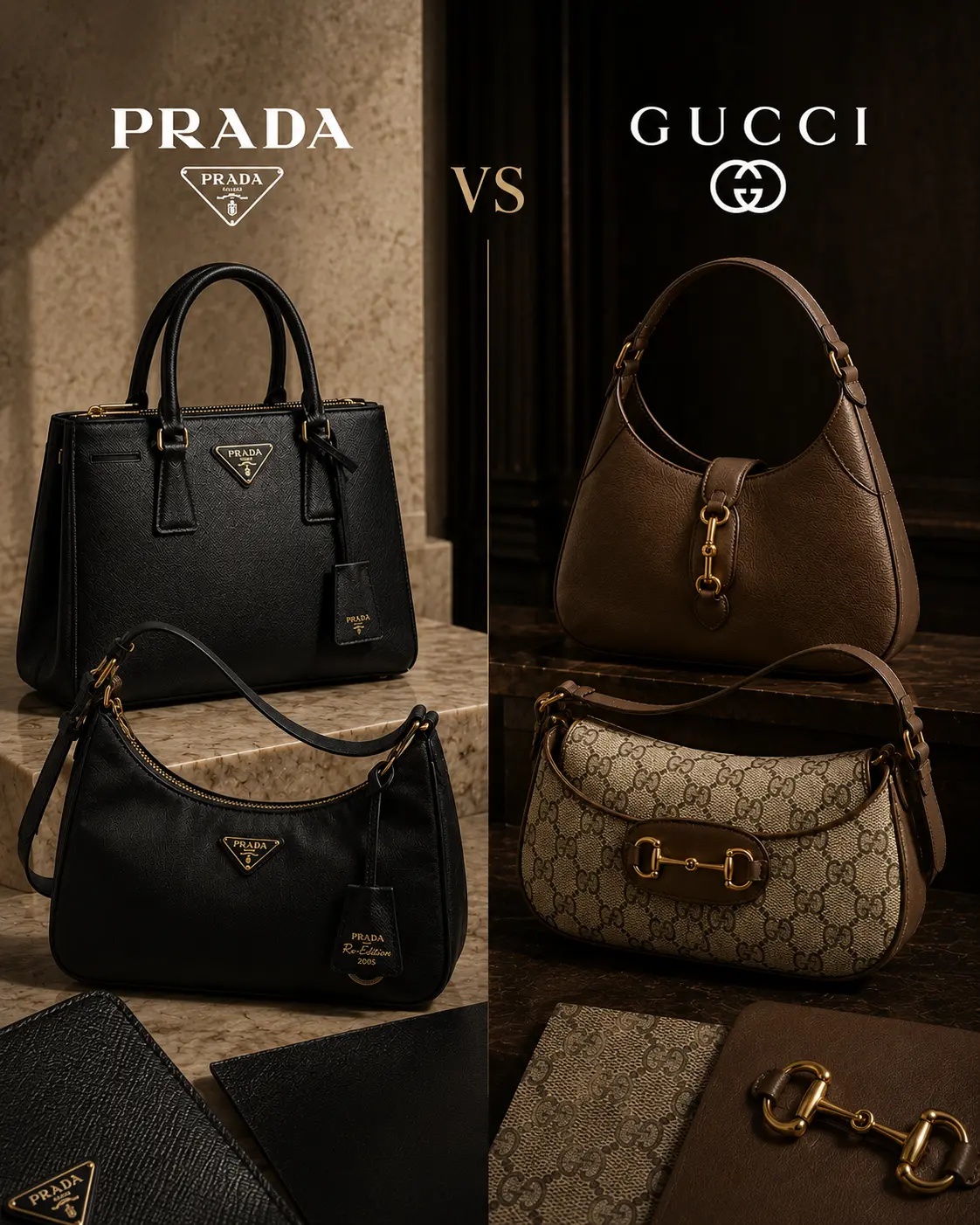
Compare Prada vs Gucci in 2026 across pricing, craftsmanship, resale value, popularity, investment potential, and luxury brand positioning to determine which designer brand fits your style and budget.
Luxury Fashion Intelligence — Insights Card
Coverage
16 Sections
Perspective
Consumer + Designer Signals
Houses
Prada Group · Kering (Gucci)
Updated
2026

01
Heritage & Provenance
Two Italian maisons, one city apart, built on opposing philosophies. Understanding their founding DNA explains every design decision, price point, and cultural alliance that follows.
Prada
Est. 1913, Milan
Mario Prada founded the house in 1913 as a leather goods shop on the Galleria Vittorio Emanuele II in Milan — a purveyor of luggage, handbags, and accessories to the Italian aristocracy. The provenance was unapologetically functional. For decades the maison operated as a respected but regional atelier, supplying the Savoy royal family and refining its savoir-faire in leather and hardware.
The transformation came in 1978 when Miuccia Prada, granddaughter of the founder, inherited a near-bankrupt business and, alongside businessman Patrizio Bertelli, systematically rebuilt it into one of the most intellectually rigorous fashion houses on earth. Miuccia's background in political science and mime theatre — not fashion — produced a designer uniquely suspicious of beauty for its own sake. This biographical fact is not incidental: it is the engine of everything Prada has become.
The house code is intentional contradiction. Prada designs things that are simultaneously sophisticated and awkward, luxurious and utilitarian, desirable and deliberately resistant to easy desire. The triangle logo — simple, geometric, unornamented — summarises the philosophy in a single mark. Prada is not trying to seduce you. It is asking you to think.
Gucci
Est. 1921, Florence
Guccio Gucci founded his house in Florence in 1921, drawing on his time working at the Savoy Hotel in London and his reverence for English equestrian culture. The early language of the maison — horsebit hardware, green-red-green webbing straps, the bamboo handle — was borrowed from the British aristocracy and filtered through Florentine artisanal craft. Gucci's founding thesis was aspiration made tactile.
The house's history is more turbulent than Prada's: family feuds, a founder's murder, near-bankruptcy in the 1980s, and a dramatic resurrection under Tom Ford and Domenico De Sole in the 1990s that transformed Gucci from a faded logo into a global sex symbol. Ford's Gucci was unapologetically decadent — velvet, exposed skin, GG buckles — and established the template that Alessandro Michele would later maximise in the 2010s with his cottagecore-meets-baroque vision, achieving cultural saturation few luxury houses have matched.
Gucci's house code is abundance. Where Prada withholds, Gucci gives. The Flora print, the GG Supreme canvas, the Dionysus clasp, the Ophidia web stripe — the house has always believed that more is more, and that luxury should announce itself. Currently navigating a quieter, more tailored identity under creative director Sabato De Sarno, the house is in a rare moment of reinvention.


Aesthetic Intelligence
02
Aesthetic & Design DNA
Prada's intellectual anti-fashion tension against Gucci's maximalist camp — two approaches to luxury that represent fundamentally different beliefs about what fashion is for.
Miuccia Prada coined the concept of ugly-chic decades before it entered the fashion lexicon, and has spent her career interrogating why certain things are considered beautiful in the first place. Prada collections routinely introduce elements that are jarring, ungainly, or intellectually resistant — a hemline that hits wrong, a print that clashes deliberately, a silhouette that challenges proportion — and makes them feel inevitable by season's end. This is anti-fashion operating at the highest level of craft.
The aesthetic vocabulary is precision minimalism crossed with conceptual provocation. Palette tends toward muted, complex tones — dusty rose, tobacco brown, school-uniform navy — punctuated by exactly one disruptive choice. The Saffiano leather's cross-hatch texture is simultaneously humble and distinctive. The nylon anorak was introduced as a winking provocation — industrial fabric at couture prices — and became a cultural touchstone for stealth wealth long before that phrase existed.
The 2020 co-creative partnership with Raf Simons layered his deconstructivist, youth-culture-inflected sensibility alongside Miuccia's cerebral feminism. The result is a house that now occupies the intersection of intellectual fashion and emotional directness — arguably the most interesting position in luxury today.
Gucci under Alessandro Michele (2015–2022) became the defining example of maximalist camp in contemporary fashion. Michele's Gucci was a Gesamtkunstwerk — a total work of art — in which every element, from bee embroideries to Renaissance portraits on silk, contributed to an overwhelming sensory experience. This was dopamine dressing before the term existed: fashion designed to produce pure, uncomplicated joy through abundance and eclecticism.
The aesthetic drew explicitly from the camp tradition Susan Sontag described in 1964 — artifice over authenticity, decoration as statement, the beautiful failure of excess. Michele's GG Marmont, with its matelassé quilting and brass chevron, or the Dionysus with its tiger-head clasp, were wearable manifestos. The clothes mixed English tailoring with Japanese street style, Greek mythology with 1970s Roman excess. Nothing was too much.
Sabato De Sarno's arrival in 2023 marked a deliberate pivot toward what the industry calls Gucci Ancora — a quieter, more tailored, deeply Italian sensibility that references the house's pre-Michele heritage. The aesthetic is warmer, more wearable, grounded in the old money colour palette of deep reds and tobacco browns. Whether this recalibration sustains the cultural energy Michele generated remains the central question in luxury fashion.


"Prada asks you to reconsider beauty. Gucci asks you to abandon restraint. Both positions are entirely serious."
03
Pricing & Market Position
Both houses occupy the upper echelon of accessible luxury, but their pricing philosophies and product tier structures differ in ways that matter for purchase decisions.
Category | Prada | Gucci |
|---|---|---|
Entry SLG | Card holders from from $220 · Wallets from from $380 | Card holders from from $195 · Wallets from from $315 |
Entry handbag | Re-Edition 2000 mini from from $1,050 | Ophidia mini from from $860 · GG Marmont mini from from $980 |
Mid-tier bag | Cleo from from $1,490 · Galleria small from from $2,050 | GG Marmont medium from from $1,420 · Dionysus medium from from $1,850 |
Investment bag | Galleria large from from $3,250 | Jackie 1961 large from from $2,700 · Bamboo 1947 from from $3,200 |
Entry RTW | T-shirts from from $430 · Knitwear from from $830 | T-shirts from from $350 · Knitwear from from $750 |
Sneakers | Cloudbust from from $720 · Downtown from from $830 | Ace from from $640 · Horsebit loafer from from $830 |
Belt | Saffiano belt from from $350 | GG Marmont belt from from $315 · GG buckle from from $375 |
Prada prices slightly higher than Gucci across comparable categories, a gap that reflects the house's more restrained use of logo and its emphasis on material quality as the primary value signal. Prada's pricing is tied consistently to its Saffiano leather and Re-Nylon — materials with strong brand equity — and to the austere manufacturing philosophy of its Tuscany workshops.
Gucci's pricing is more elastic and trend-sensitive. Hero products like the GG Marmont have increased significantly in price over the past decade — a deliberate strategy to reinforce luxury positioning. The entry price point on small leather goods remains slightly below Prada's, making Gucci the more accessible first step into Italian luxury for many consumers.

04
Status & Perceived Prestige
Prestige in luxury is not simply a function of price — it is a convergence of critical reception, cultural positioning, scarcity perception, and who is seen carrying the brand. Both houses command significant status, but they mean different things in different rooms.
Prada occupies a position of insider prestige — the status it confers is legible primarily to people who know fashion. The triangle logo is deliberately understated; the Saffiano texture and clean lines read as expensive rather than branded. This is why Prada has become the house of choice for the stealth wealth aesthetic and old money dressing: it rewards knowledge over recognition.
Within the fashion industry, press, and academia, Prada's critical standing is arguably unmatched. Fondazione Prada's programme of contemporary art exhibitions and its intellectual adjacency position the brand at the intersection of fashion and culture in a way no other luxury house has achieved as consistently. Among editors, stylists, and designers, Prada is the reference.
Gucci's prestige is broader and more legible. The GG monogram, the horsebit, the green-red-green stripe — these are among the most recognised luxury signals on earth, readable across income levels and cultural contexts. This visibility is a double-edged asset: it generates enormous aspirational pull while simultaneously making Gucci the preferred brand of those entering luxury for the first time.
The brand's pop culture dominance — from Harry Styles to Beyoncé, from hip-hop to K-pop — has given it a cultural ubiquity that Prada has never sought and would not welcome. Gucci is the luxury brand most people mean when they say "luxury brand." That reach is its own form of prestige, albeit a different kind.
"Prada is what fashion insiders wear. Gucci is what the world recognises. Neither position is superior — they serve different audiences in different moments."


Product Intelligence
05
Product — Handbags
The most searched comparison in luxury fashion. Both houses have built multi-generational bag franchises — here is how the flagship models compare across style, material, and investment logic.
Prada
From from $1,050

The bag that made Re-Nylon a cultural movement. Originally designed in 1995 and relaunched in 2019, it is the definitive statement on how industrial material can become luxury. Lightweight, functional, generationally coded. The triangle logo hardware is its only decoration.
Gucci
From from $980 (mini)

The defining bag of Gucci's Michele era. Matelassé chevron quilting in smooth leather, double G brass hardware at the centre. Available in over a dozen sizes and colourways. Among the most recognisable It-bags of the 2010s and still central to Gucci's commercial offer.
Prada
From from $2,050 (small)

Introduced in 2007, the Galleria is Prada's most architectural bag — a structured tote in Saffiano leather with minimal hardware and impeccable proportion. It is the serious-wardrobe purchase: an office bag, travel bag, and investment piece simultaneously. Available in both Saffiano and smooth calf leather.
Gucci
From from $1,850 (medium)

Named for the Greek god and fastened with a tiger-head clasp that has become one of the most distinctive closures in luxury. Available in GG Supreme canvas, suede, and leather. The Dionysus is Gucci's most editorial bag — it reads as a fashion statement rather than a functional object, which is precisely the point.
Prada
From from $1,490

A new classic introduced in 2020. The Cleo's brushed leather, arc silhouette, and interior zip pocket make it the most wearable bag in the current Prada line — simultaneously relaxed and precise. It captures the Raf Simons influence: a youth-adjacent shape with Prada's material rigour.
Gucci
From from $1,640 (small)

Originally carried by Jackie Kennedy in the 1960s and relaunched as the Jackie 1961, this is Gucci's most historically grounded bag. The distinctive piston closure and hobo silhouette are rooted in house heritage rather than seasonal trend. Available in leather and suede. A genuine archive piece.
06
Product — Footwear
Footwear is the most democratic entry point into both houses. Prada's utilitarian-luxury hybrids against Gucci's loafer heritage and fashion-week sneaker presence.
The Cloudbust sneaker — introduced under Miuccia's direction and refined with Raf Simons — is the flagship statement: a chunky, technical silhouette with an oversized sole unit that reads as sportswear and luxury simultaneously. The Downtown Oxford and the chunky leather sneaker expand the range into more classic territory. Prada loafers, particularly the brushed leather slipper loafer, have become a staple of the quiet luxury wardrobe. The house's approach to footwear is consistent with its broader philosophy: function is never hidden, and the best materials are applied to shapes that could exist outside fashion entirely.
Gucci's footwear heritage is anchored in the Horsebit loafer — one of the most replicated shoe designs in history, originally created in 1953 and still central to the house's shoe offer. The Gucci Ace sneaker, introduced under Michele, brought the house's embroidery and appliqué language into sportswear; it remains one of the most searched Gucci shoe styles. Gucci's mules and slides — particularly the Princetown backless loafer in fur or leather — achieved extraordinary cultural penetration in the 2010s. The house's shoe range is broader and more trend-driven than Prada's.


07
Materials & Construction
Both houses manufacture in Italy and apply rigorous quality standards. The differences lie in material philosophy, construction transparency, and what each brand considers the primary carrier of value.
Prada's material identity rests on two pillars: Saffiano leather and Re-Nylon. Saffiano — a wax-treated full-grain leather with a cross-hatch texture achieved through a machine process patented by Mario Prada — is extraordinarily durable, scratch-resistant, and ages without patina (which purists debate endlessly). It is not the most sensuous leather available, but it is among the most reliable.
Re-Nylon is the recycled nylon derived from ocean plastic and industrial waste, produced in partnership with Aquafil under the ECONYL regeneration process. Its introduction signals Prada's industrial design influence — the house has always treated material innovation as a creative act equal to silhouette. Construction quality on Prada leather goods is meticulously consistent; stitching, hardware attachment, and edge finishing are benchmarks for the industry.
Gucci's primary material stories are GG Supreme canvas — the jacquard-woven coated fabric carrying the interlocking G monogram — and smooth calf leather. The GG Supreme canvas is technically durable and resistant to water and abrasion; it is also explicitly logo-forward. Smooth calf leather in Gucci's bags tends toward softer, more sensuous hides that develop patina with age — a different proposition from Prada's Saffiano.
Construction quality at Gucci is high but has historically shown more variation across product lines and seasons than Prada. The embroidery, appliqué, and decorative hardware that characterise many Gucci pieces are executed to jewellery-level standards; the bamboo handle on the Bamboo 1947, heat-shaped by skilled artisans in the original Florence atelier tradition, is among the most distinctive construction details in luxury.
08
Resale & Investment Value
Luxury bags are increasingly purchased as financial assets alongside fashion objects. The resale ecosystem — Vestiaire Collective, The RealReal, Rebag — provides real-time data on which pieces hold and appreciate in value.
Prada's resale performance is strong and remarkably consistent. The Galleria in Saffiano leather retains approximately 65–75% of its retail value on the secondary market, with minimal depreciation over five-year periods. The Re-Edition 2000 nylon bags command strong resale, particularly limited colourways. Prada's restrained production and avoidance of seasonal trend-chasing work in its favour on the secondary market: pieces feel relevant across years rather than dated after 18 months.
The most investment-grade Prada pieces are typically Saffiano leather bags in black or neutrals, Re-Nylon styles in classic configurations, and limited-edition collaborations. Vintage Prada — particularly 1990s nylon backpacks and mini bags — trades at premiums that rival contemporary retail pricing on platforms like Vestiaire Collective and The RealReal.
Gucci's resale picture is more complex. Trend-defining pieces from the Michele era — certain GG Marmont configurations, Dionysus styles — command strong secondary prices due to their cultural significance. However, the sheer volume of GG Marmont production over the years has created supply saturation on secondary platforms, with some common colourways retaining only 40–55% of retail value.
The highest-performing Gucci pieces on the secondary market are archive styles — pre-2000 horsebit bags, original Bamboo bags, Tom Ford-era pieces — which are treated as collectibles rather than accessories. The Jackie 1961 and the Gucci Bamboo 1947, due to their heritage narrative and limited production, hold value better than mass-produced canvas styles. Authentication — via serial number, dust bag, and hardware quality — is a primary concern in Gucci pre-owned purchasing given the brand's counterfeiting prevalence.
Designer Signals
09
Designer Signal — Creative Direction
The most consequential factor in understanding either house right now. Both brands are in structurally unusual creative moments — Prada with its co-creative experiment, Gucci rebuilding identity after its most commercially successful period.
Co-Creative Model
The Miuccia Prada and Raf Simons co-creative directorship, established in 2020, is structurally unlike any arrangement in contemporary luxury. Two designers with distinct but complementary intellectual frameworks — Miuccia's political feminism and conceptual rigour, Raf's deconstructivist youth culture and emotional directness — create collections together, credit shared, no hierarchy declared.
The practical result is collections with greater tonal range: the emotional intensity of Raf's work alongside the cerebral distance of Miuccia's. The Fall 2024 collection's exploration of workwear-as-uniform and the Spring 2025 show's forensic investigation of the garment's relationship to the body are examples of collaborative complexity that neither designer would likely have reached alone. Within the industry, this is considered one of the most interesting creative experiments currently running in fashion.
Fabric innovation remains central: each season introduces new material stories — bonded nylons, engineered Saffiano finishes, technical wools — that function as design statements rather than background decisions. Silhouette shifts are deliberate and precisely calibrated, making Prada a primary reference for trend forecasting at WGSN and Trendalytics.
Identity Reconstruction
Sabato De Sarno took the creative directorship of Gucci in January 2023 following Alessandro Michele's departure — a transition that ended one of the most culturally dominant creative visions in recent fashion history. De Sarno's first collection, shown in September 2023 under the concept "Ancora" (Italian for "still" and "again"), signalled a deliberate move away from Michele's maximalism toward a quieter, more personal vision grounded in deeply Italian sensibility.
De Sarno's Gucci draws on tailoring, precise colour work — his use of a specific deep red, immediately dubbed "Ancora red" — and a more restrained relationship to the house archive. The show set design shifted from Michele's theatrical installations to simpler, more focused environments. Critics received the transition with measured interest; commercial response has been watched closely as Kering navigates a significant revenue recalibration.
From a designer signals perspective, the Gucci creative directorship change represents one of the most significant silhouette and vocabulary pivots in current luxury. Emerging designers and stylists who built references around Michele's house codes are in the process of recalibrating, which makes this an unusually fertile moment of creative ambiguity.


10
Designer Signal — Show Production
How each house frames its collections physically and narratively — the show environment as an extension of the design statement, and how press and buyers read both houses during Milan Fashion Week.
Prada's long-standing collaboration with Rem Koolhaas and OMA/AMO — the architecture and research arm of OMA — has produced some of the most discussed show environments in contemporary fashion. The Fondazione Prada's Deposito space in Milan has become the primary venue: a brutalist industrial building that rejects the decorative grandeur of traditional fashion show staging. Sets are architectural statements — structural interventions rather than mood boards.
Critical reception of Prada collections in the trade press and in publications like System Magazine and Vestoj is consistently substantive. Collections are reviewed for their conceptual logic as much as their wearability. The WWD and Vogue Runway coverage of Prada shows tends to engage with the designers' stated intentions — an unusual dynamic that reflects the house's intellectual authority with fashion editors.
Casting at Prada has historically been diverse in age and cultural background, and increasingly non-binary in presentation. The house was among the first to cast women over 60 in prominent runway roles and has consistently pushed back against the homogeneity of luxury fashion casting. This is read as both an ethical statement and a creative one.
Alessandro Michele's Gucci shows were events in the fullest sense — theatrical spectacles staged in Roman amphitheatres, mirrored infinity rooms, and recreated operating theatres, with casting that drew from the full range of human appearance regardless of age, size, or conventional beauty standards. Each show had a narrative concept communicated through set, casting, and look that operated simultaneously as fashion and as cultural commentary. The critical response was consistently rapturous.
De Sarno's approach to show production is notably more restrained. The Ancora collections have been presented in stripped-back environments that place the clothes rather than a concept at the centre. Critical reception has been respectful but measured — most reviews note the quality of tailoring and the precision of De Sarno's colour work while acknowledging that the house is in a transitional creative period.
Gucci's fashion week presence remains enormous — no brand generates more street style content during Milan Fashion Week — but the editorial conversation around each collection has shifted from cultural event to craft assessment. For designers reading the signal, this represents a house momentarily more legible as a craft reference than a cultural one.


11
Designer Signal — References & Influences
Where each house draws its conceptual and visual material from. For designers, stylists, and educators, these lineages are the essential context for reading collections correctly.
Prada's reference architecture is built from conceptual art, architecture, and political philosophy. The house's relationship with Fondazione Prada — one of the most serious contemporary art foundations in Europe, with exhibitions curated by figures like Germano Celant — is not a sponsorship arrangement but an intellectual alignment. Miuccia Prada consistently cites film (particularly Visconti and Pasolini), second-wave feminism, and Bertolt Brecht's epic theatre as reference points.
Raf Simons brings a parallel lineage: Belgian conceptualism from his years under Walter Van Beirendonck at the Antwerp Royal Academy, youth subculture (skinhead, rave, post-punk), the art practices of Sterling Ruby and Robert Mapplethorpe, and the architectural minimalism of Mies van der Rohe. The collision of these two reference systems is what makes current Prada collections so layered.
For design students, Prada is the primary reference for how intellectual and cultural material can be translated into fashion without becoming literal illustration. The banana print collection, the nylon-as-luxury intervention, and the Re-Edition recontextualisation are case studies in how design thinking operates at the highest level of the industry.
Michele's Gucci drew from the widest possible reference field: the Romantic poets, Japanese street style, Renaissance portraiture, 1970s New York decadence, cottagecore, gender theory, and the literary tradition of the uncanny. These were not superficial citations but deeply researched visual languages synthesised into a coherent maximalist aesthetic. Show notes were essays; the casting brief was a philosophical position on beauty.
The house codes that predate Michele — equestrian culture, the Flora print commissioned for Grace Kelly in 1966, the bamboo and horsebit hardware — draw from a more specific Italian bourgeois tradition. Tom Ford's 1990s references were cinematic glamour and Studio 54 excess. Each creative director at Gucci has brought a distinct intellectual framework to essentially the same set of house assets, which makes the archive unusually rich for students studying how a maison evolves.
De Sarno's current reference field is more personal and less explicitly cited — a felt sense of Italian warmth, emotional colour, and tactile quality. For designers, this moment of quieter referencing at Gucci is actually instructive: it demonstrates how restraint and reduction can function as a creative position after a period of maximum complexity.


12
Ethics & Sustainability
Sustainability in luxury is an increasingly searched topic — both brands have made significant commitments, but their approaches reflect their design philosophies as much as their environmental ambitions.
Prada's Re-Nylon initiative — the conversion of the entire nylon production to ECONYL regenerated nylon from ocean plastic, fishing nets, and industrial waste — is the most substantive material sustainability commitment made by a major luxury house. Launched in 2019 and completed across all nylon products by 2021, it transforms the house's most iconic material into an environmental statement without altering its aesthetic properties.
The Prada Group has committed to Science Based Targets for carbon reduction and publishes detailed annual sustainability reports. The house's supply chain is primarily Italian, limiting transport emissions and supporting the regional craft economy. Prada has resisted the trend toward seasonal collection inflation: the brand operates on a relatively restrained product calendar that reduces overconsumption pressure.
Gucci Equilibrium is the house's sustainability and social impact platform, encompassing environmental targets, worker welfare commitments, and cultural initiatives. Gucci was among the first major houses to achieve carbon neutrality certification for its operations — though the use of carbon offsets in that calculation has attracted academic scrutiny. The house's Circular Hub, a textile recycling platform in Tuscany, processes production waste into new materials.
Gucci's parent company Kering has been a leading voice in luxury sustainability at the industry level, publishing a standardised Environmental Profit and Loss methodology that has been adopted across the sector. The group's 2025 sustainability strategy includes ambitious supply chain traceability commitments. For consumers purchasing with ethical considerations, both houses are materially more committed than most luxury peers — but both also operate at volumes that generate significant environmental footprint.
13
Business Intelligence
Prada Group vs Kering — a study in contrasting corporate structures, growth trajectories, and the strategic decisions behind two of fashion's most important balance sheets.
Prada Group is unusual among luxury conglomerates in remaining family-controlled: Miuccia Prada and Patrizio Bertelli, through their holding company, retain majority ownership of the publicly listed group on the Hong Kong Stock Exchange. The group's portfolio is deliberately narrow — Prada, Miu Miu, Church's shoes, and Car Shoe — compared to the vast portfolio structures of LVMH and Kering.
Prada Group has been among the strongest performers in luxury over the 2023–2025 period, posting double-digit revenue growth driven by both the Prada brand and a remarkable resurgence of Miu Miu, which became one of the fastest-growing luxury brands globally. The group's Asia-Pacific focus — approximately 40% of revenue — proved advantageous as Chinese luxury consumption recovered post-pandemic. The independence of the group structure is considered a strategic asset: decisions are made with a long-term design perspective rather than quarterly earnings pressure.
Gucci is the flagship brand of Kering, the French luxury conglomerate that also owns Saint Laurent, Bottega Veneta, Balenciaga, and Alexander McQueen, among others. Gucci has historically generated approximately 50% of Kering's total group revenue — an extraordinary concentration that makes the brand's performance the primary determinant of Kering's financial health.
The brand's revenue declined significantly in 2024 following the creative transition from Michele to De Sarno and amid broader Chinese luxury market softness — a widely covered recalibration that Kering management has described as a deliberate repositioning toward higher price points and reduced commercial dependency on entry-level products. The comparison between Prada Group's growth trajectory and Kering/Gucci's revenue contraction has become one of the most discussed narratives in luxury business analysis. For industry observers, it illustrates the tension between creative disruption and commercial continuity at the highest level of the market.
Buying Guide
14
Buying Guide
The question most luxury buyers are actually asking. Mapped by use case, occasion, aesthetic sensibility, and where you are in your luxury journey.
You are... | Prada | Gucci |
|---|---|---|
First luxury bag | Re-Edition 2000 nylon — an intellectual entry point that doesn't look like a beginner's purchase | GG Marmont mini or Ophidia — more recognisable, immediate impact, strong gifting choice |
Office / work bag | Galleria in Saffiano — the definitive professional luxury bag | Jackie 1961 medium — structured, discreet, heritage-coded |
Everyday casual | Cleo or Re-Edition 2000 — understated and functional | GG Marmont shoulder or Gucci Blondie — relaxed and recognisable |
Gift for her | Re-Edition mini, Prada wallet — precise, appreciated by fashion knowledge | GG Marmont, Gucci belt — immediately legible luxury, universally understood |
Gift for him | Prada nylon backpack, Saffiano cardholder — functional luxury | Gucci belt, Ace sneaker — strong recognition, gifting classic |
Investment / resale | Galleria black Saffiano, Re-Edition nylon — strong retention | Jackie 1961, archive styles — best Gucci resale performance |
Fashion industry / editorial | Almost always Prada — the industry reference | For cultural commentary, colour, maximalism — Michele-era pieces |
Travel bag | Re-Nylon tote or backpack — lightweight, durable, washable | Gucci Ophidia GG canvas — water-resistant, heritage feel |
15
Pre-Owned & Authentication
Both brands are among the most counterfeited in the world. Whether buying on Vestiaire Collective, The RealReal, or from a private seller, knowing the authentication signals is essential.
Serial number: Authentic Prada bags carry a black interior authenticity card with embossed gold lettering and a serial number. From 2018, Prada migrated to QR-code authentication tags embedded in the lining — scan with a smartphone to verify.
Hardware: Prada hardware is weighty, precisely finished, and engraved rather than stamped. The triangle logo plaque on handbags should be flush-mounted, with uniform spacing between letters. Screws visible on hardware backs indicate a replica.
Saffiano leather: Genuine Saffiano has a consistent cross-hatch texture with very slightly waxy feel. The wax coating means it resists scratching — a pre-owned Saffiano bag in good condition shows minimal surface wear. Replicas often produce a plastic or overly shiny finish.
Dust bag: Black nylon with white drawstring and white triangle logo print. Pre-2014 dust bags were beige. Interior lining is typically black for leather goods. Mismatched dust bags are a common tell.
Serial number: Gucci bags carry a leather patch inside the main compartment with a serial number heat-stamped in two rows — the style number above, the supplier number below. Post-2016 bags may have a QR authentication code. The font should be precise and even; blurred or uneven stamping indicates a fake.
Hardware: Gucci hardware is solid brass, aged or polished. The interlocking G should be perfectly symmetrical with clean, sharp edges. On the Horsebit, the metal bar passes cleanly through the rings with no wobble. Hardware screws on genuine bags are not visible from the exterior.
GG Supreme canvas: The canvas warp and weft of genuine GG Supreme is tight and consistent, with the GG pattern aligned perfectly at seams. The canvas is stiff but not brittle. Replicas often show pattern misalignment at seams or an overly glossy coated surface.
Dust bag: Cream cotton with brown drawstring and Gucci wordmark in brown, or black cotton with gold — varies by era. Leather goods tags should be attached with a gold lobster clip. The dust bag alone does not authenticate — request full provenance documentation when buying pre-owned Gucci.
16
Final Assessment
Neither house is superior — they represent genuinely different positions in the luxury landscape. But for specific needs, buyers, and moments, one or the other is clearly the right choice.
Prada — the Saffiano leather standard and consistent construction quality across all product lines makes it the more reliable long-term purchase.
Prada — the critical and intellectual reference that stylists, editors, and designers reach for first. The co-creative model with Raf Simons is the most discussed experiment in luxury right now.
Prada — more consistent retention across categories. The Galleria in black Saffiano is one of the most reliable value-retention purchases in contemporary luxury.
Gucci — no contemporary luxury house has generated more cultural conversation, celebrity alignment, or pop culture penetration over the past decade.
Gucci edges it — broader recognition, slightly lower entry prices, and the immediate legibility of a GG Marmont or Horsebit loafer make it a more universally understood luxury statement.
Both, for different reasons. Prada's co-creative model is at peak creative output. Gucci's identity reconstruction under De Sarno is one of the most consequential creative transitions in the industry.
"Buy Prada to invest in craft and intellect. Buy Gucci to invest in culture and joy. The most interesting wardrobes contain both."