Luxury eCommerce • Designer Shopping • Platform Comparison
Luxury Retail Platform Comparison6 min read

Farfetch Vs mytheresa

Compare Farfetch vs Mytheresa in 2026 across luxury brand selection, pricing, authenticity, delivery, customer experience, resale value, and premium shopping services.

The Designer Vault Research DeskMay 20, 2026
Explore related guide
farfetch-vs-mytheresa hero banner

Designer Signal — Platform Intelligence · 2026

Farfetch vs Mytheresa

The two platforms that defined luxury e-commerce are in radically different

positions heading into 2026. One rebuilding from near-collapse. One

absorbing a rival to build a $3B empire.

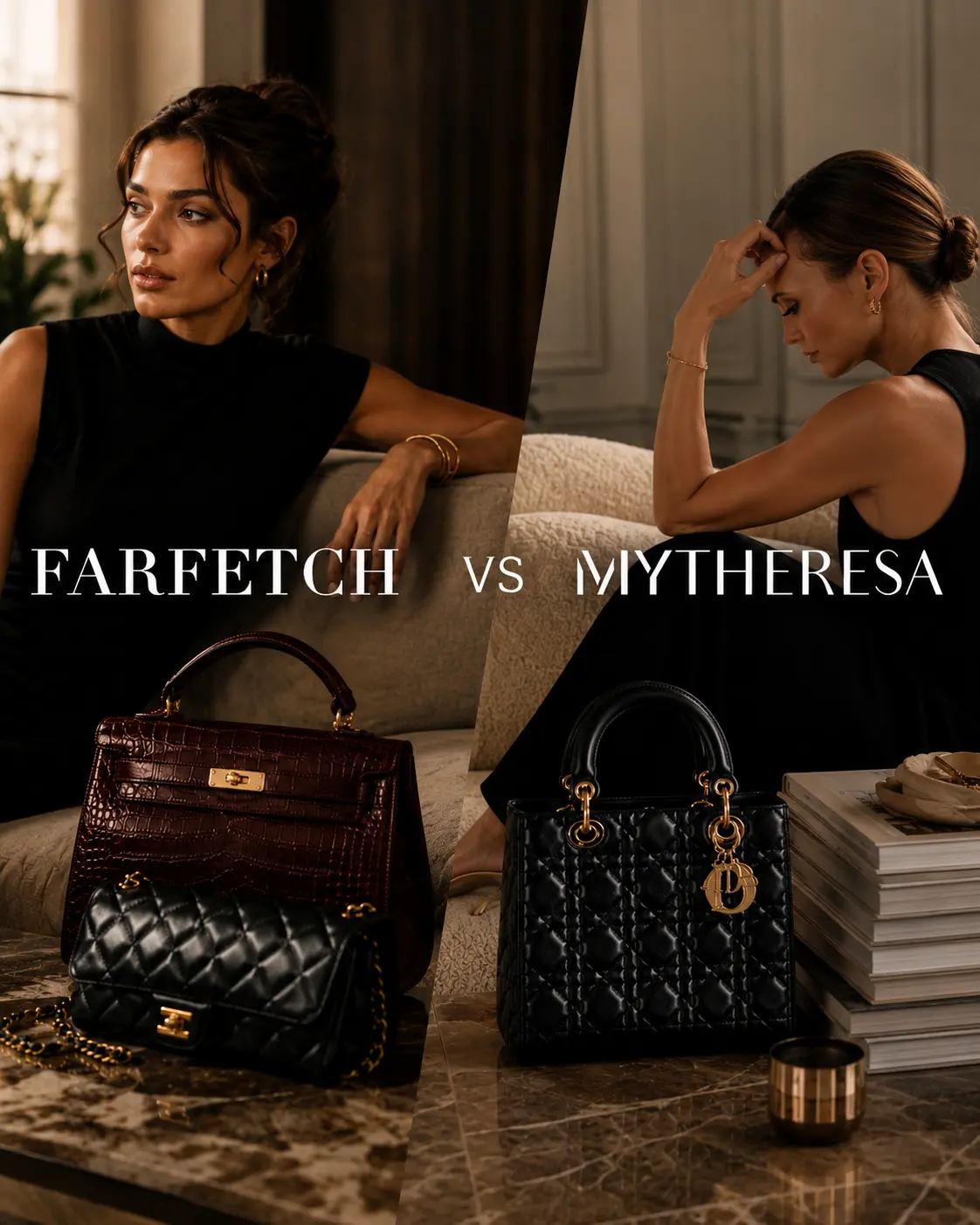
Banner of farfetch-vs-mytheresa

01

Platform Overview

What Each Platform
Is Right Now

The competitive landscape for luxury e-commerce has been redrawn entirely since 2023. Understanding both platforms requires understanding the seismic corporate events that define each one today.


Critical context before you read anything else. Farfetch was acquired by South Korean e-commerce giant Coupang in January 2024 following a near-bankruptcy crisis. Mytheresa completed its acquisition of YOOX NET-A-PORTER from Richemont in April 2025, forming a new group entity called LuxExperience B.V., operating Mytheresa, Net-a-Porter, Mr Porter, Yoox, and The Outnet under one roof. Any comparison written before mid-2025 is structurally outdated.

Farfetch

Est. 2007 · Now owned by Coupang


Farfetch was founded in 2007 by Portuguese entrepreneur José Neves as a digital marketplace connecting independent luxury boutiques worldwide to a global audience. The concept was genuinely revolutionary: rather than holding inventory, Farfetch created a technology layer that allowed over 700 boutiques, brands, and department stores to sell simultaneously through one storefront. At its peak, Farfetch was valued at over $23 billion and positioned as the inevitable infrastructure of luxury e-commerce.

The collapse was equally dramatic. A combination of over-leveraged acquisitions — including streetwear holding company New Guards Group, beauty retailer Violet Grey, and AR startup Wannaby — alongside rising interest rates and slowing luxury spending created a $2.8 billion debt crisis that culminated in Farfetch cancelling its Q3 2023 earnings call and a Fitch downgrade to CC. South Korean e-commerce giant Coupang acquired the business for $500 million in January 2024, taking it private and replacing founder José Neves as CEO.

Under Coupang's ownership, Farfetch is in active reconstruction: slashing markdown activity, extending returns to 30 days, cutting costs, and refocusing on its core marketplace model. The platform still serves over four million customers and connects them to hundreds of boutiques across more than 50 countries. The question for shoppers is whether the post-crisis Farfetch still delivers the discovery-driven, global luxury experience it once defined.

Mytheresa

Est. 1987 (Munich boutique) · Now LuxExperience


Mytheresa began as a physical luxury boutique in Munich in 1987 before launching its online platform in 2006. Unlike Farfetch's marketplace architecture, Mytheresa operates as a direct retailer: it buys inventory wholesale from brands and ships every order from its centralized Munich warehouse. This single-warehouse model is the foundation of its most praised attributes — consistent, fast shipping, predictable pricing, and a cohesive curation philosophy that a marketplace cannot replicate.

In October 2024, Mytheresa signed agreements to acquire YOOX NET-A-PORTER from the Swiss luxury group Richemont, closing the deal in April 2025. The combined entity — now operating under LuxExperience B.V. (NYSE: LUXE) — includes Mytheresa, Net-a-Porter, Mr Porter, Yoox discount platform, and The Outnet off-price channel. CEO Michael Kliger's stated ambition is to build a €4 billion digital luxury group, with the restructuring of the YNAP businesses expected over 24 to 36 months.

For shoppers engaging with Mytheresa directly, the shopping experience remains unchanged: the same Munich-based fulfilment, the same curated brand roster, the same elevated service model. The LuxExperience merger is a back-of-house operational reality, not yet visible at the storefront level — but it positions Mytheresa as part of the most significant consolidation event in luxury e-commerce history.

Farfetch platform view
Mytheresa platform view


02

Business Model

Marketplace
vs Direct Retailer

The single most important structural difference. It explains every variation in pricing, shipping consistency, curation depth, and shopper experience that follows.

Farfetch


Farfetch is a global luxury marketplace — it does not own the products you purchase. When you buy through Farfetch, the transaction is fulfilled by one of its boutique, brand, or department store partners, which may be located anywhere from Milan to Tokyo to São Paulo. Farfetch provides the technology infrastructure, payment processing, customer service layer, and global logistics coordination, but the goods ship from the partner's physical location.

This model has enormous strengths: it creates access to inventory that a single warehouse could never stock, enables genuine discovery of boutique-exclusive pieces, and theoretically offers the deepest product breadth in luxury e-commerce. A rare Marni coat in a Florence boutique and a vintage Helmut Lang jacket in a Tokyo archive store can exist in the same checkout. No other platform replicates this geographic reach.

The trade-off is consistency. Shipping times, packaging quality, and even return procedures vary by partner. A shopper who has a seamless experience buying from a London-based boutique partner may have a very different experience with a boutique in a different country. Under Coupang's ownership, standardising this partner experience is a stated priority — but the architecture of a distributed marketplace makes full standardisation structurally difficult.

Mytheresa


Mytheresa is a direct luxury e-tailer — it buys inventory outright from brands at wholesale, holds it in its Munich warehouse, and ships every order itself. This is the same model operated by Net-a-Porter, Bergdorf Goodman online, and Browns — the traditional wholesale e-commerce architecture that pre-dates the marketplace model.

The direct retail model produces the consistency that makes Mytheresa's customer satisfaction scores among the highest in luxury e-commerce. Every order comes from the same warehouse, photographed to the same standards, packed to the same specification, and dispatched with the same DHL Express logistics partner. Returns go to the same address. Customer service agents have access to the same inventory system. The experience is architecturally uniform in a way Farfetch cannot match.

The constraint is selection. Mytheresa buys what it can afford to stock, which means its brand and product depth is narrower than Farfetch's marketplace aggregation. The editorial curation this imposes is also a benefit — the buying team's choices are necessarily deliberate — but shoppers hunting for an obscure size, a discontinued colourway, or a boutique-exclusive piece will find Farfetch's aggregate inventory the more effective tool.

"Farfetch gives you access to the entire world's luxury inventory. Mytheresa gives you a single, curated answer to the question of what to buy."

Marketplace and Direct Retailer


03

Curation & Brand Selection

Depth of Selection
& Curation Philosophy

Volume versus intentionality. Farfetch's staggering inventory breadth against Mytheresa's deliberate buying team curation — two entirely different answers to the question of what a luxury platform should offer.

Farfetch


Farfetch carries products from over 700 boutique and brand partners, giving it access to an inventory depth no single warehouse retailer can approach. The platform spans ultra-luxury (Loro Piana, Brunello Cucinelli, Bottega Veneta), accessible luxury (Maje, Sandro, Ganni), streetwear (Supreme, Palace, Off-White), vintage and archive, and contemporary independent designers — all simultaneously. This is luxury e-commerce as a department store of the internet, and for discovery-mode shoppers it is genuinely unmatched.

The curation challenge is the absence of a single editorial voice. Because Farfetch aggregates inventory from hundreds of partners, the visual and editorial coherence of any given category page reflects the aggregate of multiple buying decisions, photography standards, and product descriptions. The algorithmic personalisation Farfetch has invested in helps, but the platform's feel is closer to a well-organised bazaar than a curated boutique. Under Coupang, the editorial content strategy has been quietly deprioritised; the focus is on marketplace efficiency.

Mytheresa


Mytheresa carries approximately 200 luxury brands — a fraction of Farfetch's partner count — chosen by a Munich-based buying team operating on a deliberate curation philosophy: fewer brands, deeper stock across each. The brand roster is weighted toward the upper tier of accessible luxury and true luxury: Bottega Veneta, The Row, Celine, Prada, Loewe, Toteme, Jacquemus, Khaite, and a rotating set of emerging names that the buying team introduces seasonally. The platform does not carry streetwear, mass contemporary, or accessible high street.

The result is a platform with a recognisable editorial identity — buying Mytheresa's version of a Bottega Veneta season is buying the curation of people who have thought seriously about which pieces represent the collection's best expression. Mytheresa's exclusive capsule collections — produced directly with brands like Valentino, Gucci, and Stella McCartney — are a direct expression of this relationship model: the platform earns product exclusivity through the quality of its curation and the spending power of its customer base.

Farfetch Philosophy
Depth of Selectionand Curation Philosophy
Mytheresa Philosophy


04

Pricing & Value

Pricing, Discounts
& Value Dynamics

One of the most-searched questions: why does the same product sometimes cost different amounts on each platform — and where do you actually get the better deal?

Farfetch


Pricing on Farfetch varies by partner and currency. Because boutique partners set their own retail prices — typically in their local currency — shoppers in the US sometimes find pieces priced at a slight discount relative to US retail due to favourable exchange rates, particularly from European boutiques. This is the origin of the frequently-asked question about whether Farfetch is cheaper: it can be, but not systematically and not reliably.

Farfetch has historically run deep promotional discounts — Black Friday and end-of-season sales of 30–50% were common. Under Coupang's post-acquisition restructuring, the platform is deliberately reducing its markdown activity and clearance volume to rebuild brand relationships and protect luxury positioning. This is a deliberate shift: brands increasingly resist being discounted on major e-commerce platforms, and Farfetch's survival depends on retaining top-tier brand access.

Import duties and taxes are an important pricing variable for US shoppers. Farfetch shows duty-paid prices at checkout for most items but goods shipping from non-US boutiques may incur additional customs fees depending on the order value and the originating country. The Trump-era tariff changes of 2025 have introduced new complexity for orders shipping from certain international partners.

Mytheresa


Mytheresa prices at or very close to brand-recommended retail across its entire range. Because the platform operates on a wholesale direct model from Munich, its pricing is consistent and predictable — the same Bottega Veneta pouch will be the same price on Mytheresa as at a Bottega boutique in New York. There are no exchange rate fluctuations or partner-specific price variations. For US shoppers, prices are displayed in USD with duties and taxes calculated at checkout; Mytheresa ships DDP (Delivered Duty Paid) to the US, meaning no surprise customs fees on arrival.

Mytheresa's sale periods are precisely timed, well-executed, and respected by the brands it carries. The platform does not discount outside formal sale periods — a strategic alignment with how top luxury brands want to be sold. The Mytheresa Private Sale, available to registered customers, offers targeted discounts on a rotating edit of full-price pieces and is one of the platform's most valued loyalty mechanisms among its high-spending customer base.

Factor

Farfetch

Mytheresa

Price consistency

Variable — depends on partner and currency

Consistent — single warehouse, fixed USD pricing

vs. brand retail

Sometimes lower (exchange rate), sometimes higher

At or matching brand retail

Discount cadence

Reducing post-Coupang; was more frequent

Formal sale only; Private Sale for top customers

Duties (US)

Varies by partner origin; DDP on most orders

Always DDP — no customs surprise

Price transparency

Full price shown at checkout

Full price at checkout, all-in

farfetch vs mytheresa pricing


05

Logistics & Returns

Shipping Speed,
Returns & Reliability

For luxury online purchases, the unboxing and return experience is part of the product. One platform ships from a single hub with military consistency. The other ships from 700+ locations worldwide.

Farfetch


Farfetch shipping is a function of which partner your item is coming from. A piece shipping from a London boutique partner may arrive in New York in two to three business days. The same item held by a partner in Seoul may take five to seven. At checkout, Farfetch shows the estimated delivery window and shipping cost for each item — transparency is there, but consistency is not. Shipping is generally paid; costs vary by origin and speed selection.

The return process at Farfetch is more complex than at a direct retailer. Returns must be arranged through the Farfetch platform, but the item goes back to the original boutique partner — a process that can take longer and requires more coordination than a centralised warehouse return. Post-Coupang, Farfetch extended its free returns window to 30 days for most items, an improvement on the previous policy. However, the experience of a return still depends significantly on the responsiveness of the original partner.

Packaging quality on Farfetch varies by partner. Some boutiques pack and present orders to exceptional standards; others are more perfunctory. For a significant luxury purchase, this variability is a meaningful concern — the unboxing experience is part of what you are paying for.

Mytheresa


Mytheresa ships every order from its Munich warehouse via DHL Express. Delivery to the US typically takes one to three business days — a speed standard that luxury customers consistently rank as a primary reason for platform loyalty. The question "where is Mytheresa shipped from?" is one of the most searched about the platform; the answer is always the same: Munich, regardless of what you order or when.

Free shipping on all orders is Mytheresa's most commercially significant logistics differentiator. On a $1,500 purchase, a $30–50 shipping charge at a competitor is not trivial. The free shipping threshold-free policy removes a friction point that affects conversion rates — and it is funded by the operating economics of the centralised warehouse model.

Returns at Mytheresa are accepted within 30 days for items in original condition with tags attached. All returns ship back to Munich — the process is standardised, prepaid, and tracked. Packaging quality is consistent: signature black tissue wrap, branded boxes, and a care that communicates the product's value before it is opened. The unboxing experience is part of the Mytheresa proposition.

Farfetch Shipping Speed
Mytheresa Shipping Speed


06

Authenticity & Trust

Is It Safe to Buy
on Both Platforms?

The highest-anxiety question for luxury e-commerce shoppers. Both platforms sell exclusively authentic product — but the mechanisms and confidence levels differ.

Farfetch


Farfetch does not sell pre-owned or resale goods on its main platform — all products are sold new by authorised retail partners, which are vetted boutiques, brand-owned stores, or authorised department stores. In this sense, authenticity risk is low: you are buying from an authorised stockist, not an individual seller. The platform's partner vetting process, while not publicly detailed, has not generated significant systematic counterfeiting concerns in its main marketplace.

The trust question around Farfetch has historically been more about operational reliability than product authenticity: will the item arrive as described, in good condition, from a partner who packs and ships correctly? The platform's customer protection and dispute resolution processes are robust, and Farfetch's size and public profile create accountability that smaller boutiques do not have individually. Under Coupang's ownership, the platform's operational quality is an active focus — Coupang's expertise is in logistics and customer experience at scale.

Mytheresa


Mytheresa is an authorised wholesale retailer for every brand it carries, purchasing directly from the brands' official distribution channels. The single-warehouse, single-source model means every product that ships from Munich has been received, inspected, and stored by Mytheresa staff. Authenticity is structurally guaranteed by the supply chain architecture — there is no boutique partner variability to introduce risk.

Mytheresa is consistently rated among the most trusted luxury e-commerce platforms in independent customer surveys and review platforms including Trustpilot. The combination of official brand authorisation, centralized quality control, and a long operating history since 2006 gives it a trust profile that is difficult to question. The LuxExperience acquisition of Net-a-Porter — another platform with strong trust credentials — reinforces the group's overall authenticity positioning.


07

UX & Customer Experience

Site Experience
& Customer Service

The feel of each platform — how it is designed, how it is navigated, and what happens when something goes wrong.

Farfetch


Farfetch's platform is built on substantial technology investment — the company described itself as a technology business that happened to sell fashion, and the product discovery tools, personalisation algorithm, and visual search capabilities reflect that positioning. The breadth of inventory makes navigation more complex: filtering by boutique location, product origin, and delivery time are features that only become necessary when you have 700+ partners. The mobile app is well-regarded and accounts for a significant share of platform transactions.

Customer service at Farfetch is a tiered experience. High-spending customers — the "Extremely Important Customers" or EICs that Farfetch actively cultivates — receive dedicated personal shoppers, invitations to brand events, and concierge-level service. For standard transactions, the customer service experience has been inconsistent — a reflection, again, of the distributed partner model. Under Coupang's restructuring, customer experience improvement is a stated priority, and the extension of free returns to 30 days is a signal of that intent.

Mytheresa


Mytheresa's website and app are consistently praised for their clean editorial aesthetic, intuitive navigation, and high-quality product photography — all shot in-house at the Munich warehouse. The browsing experience reflects the platform's curation philosophy: a manageable number of thoughtfully presented products rather than an overwhelming inventory grid. The editorial content — trend guides, brand spotlights, exclusive campaign imagery — adds context that positions shopping as a creative act rather than a transaction.

Customer service at Mytheresa is its most consistent differentiator. The platform offers 24/7 support across phone, email, and live chat, with agents who have direct access to real-time inventory. Its personal shopping service — particularly for top-tier clients — provides styling advice, wishlist management, and early access to new arrivals. Customer satisfaction scores for Mytheresa are among the highest in luxury e-commerce globally, driven by the simplicity of a model where one team owns the entire customer journey from purchase to delivery to return.

Farfetch customer services
Mytheresa site experience


Platform Intelligence


08

Brand Relationships

Brand Access
& Relationships

Which brands you can find, and — crucially — how each platform's relationship with those brands affects what it can offer you.

Farfetch


Farfetch's brand relationship story is at a pivotal moment. Before the Coupang acquisition, several top-tier luxury brands — most notably Chanel, Hermès, and Rolex — had declined to participate in the Farfetch marketplace, preferring to control their own distribution. LVMH's relationship with Farfetch was particularly fraught; a 2022 partnership was terminated in 2023, shortly before the financial crisis, removing brands including Dior, Givenchy, and Celine from the platform.

Under Coupang, rebuilding brand relationships is a business-critical priority. The restructuring away from heavy discounting and clearance activity is explicitly designed to restore confidence with brands who feared Farfetch was positioning their products as markdown inventory. Whether LVMH brands return, and when, is the most consequential outstanding question for the platform's long-term appeal to serious luxury shoppers.

Mytheresa


Mytheresa's direct wholesale model creates structurally closer brand relationships. When a brand sells to Mytheresa at wholesale, it is choosing an authorised retail partner it trusts to present its products correctly, price them consistently, and deliver an experience worthy of the brand's standards. This mutual accountability is why Mytheresa has relationships with some of the most selective brands in luxury — including Bottega Veneta, The Row, and Loro Piana — that are reluctant to participate in broad marketplace platforms.

The exclusive capsule collections Mytheresa produces with brands including Valentino, Stella McCartney, and Gucci are the most visible expression of these relationships. Brands create product exclusively for Mytheresa's customer base — a level of collaboration that requires genuine trust in the platform's curation, customer profile, and operational standards. Post-LuxExperience, the combined buying power of Mytheresa, Net-a-Porter, and Mr Porter gives the group even greater leverage in brand negotiations.

farfetch brand access
Mytheresa brand access


09

Men's Luxury

For Men:
The Platform Comparison

Men's luxury is the fastest-growing segment in luxury e-commerce. Both platforms serve male shoppers — but with meaningfully different breadth, tone, and category depth

Farfetch


Farfetch has historically been one of the strongest platforms for men's luxury, particularly in categories that require significant inventory breadth: menswear from Brunello Cucinelli, Zegna, and Brioni; streetwear and sneakers from Palace, Supreme, and Fear of God; contemporary designers including Acne Studios, Jacquemus menswear, and Wales Bonner. The marketplace model's diversity is particularly valuable for men, who tend to mix luxury tailoring with streetwear and contemporary pieces across a wider range of price points than women's dressing typically demands.

Menswear is a category where Farfetch's global boutique access genuinely adds value — European menswear boutiques often carry allocations of Loro Piana, Kiton, and Cesare Attolini that are unavailable in the US, and the Farfetch marketplace provides the only practical digital access to these pieces for American shoppers.

Mytheresa


Mytheresa launched its dedicated menswear section as a formal part of its core platform in 2019 and has consistently grown its men's offer, with a selection weighted toward quiet luxury and investment dressing: Tom Ford, Loro Piana, Loewe men's, The Row menswear, and a curated sneaker and shoe selection. The platform's men's curation reflects the same philosophy as its women's offer — fewer, better — and the buying team's taste level is consistently respected by the menswear community.

With the LuxExperience acquisition of Mr Porter — Net-a-Porter's dedicated menswear channel and one of the most respected menswear platforms globally — the group's men's offer is set to expand considerably. Mr Porter operates with editorial depth, exclusive brand collaborations, and a buying philosophy that has made it the reference platform for discerning male luxury shoppers. Whether and how Mytheresa and Mr Porter cross-pollinate within LuxExperience will be one of the most watched developments in men's luxury e-commerce.

Farfetch mens luxury
Mytheresa mens luxury


Designer Signals


10

Designer Signal — Platform Intelligence

How Designers, Stylists
& Buyers Read Each Platform

For industry professionals, what a platform stocks — and which brands choose to be on it — is a signal about brand positioning strategy, distribution philosophy, and the evolving power dynamics of luxury e-commerce.

Farfetch


Platform Signal

For designers and industry professionals, a brand's presence or absence on Farfetch is a distribution strategy signal. Brands that chose to be on Farfetch — particularly during its 2018–2022 peak — were betting on the marketplace model's reach and the democratisation of luxury access. Brands that withdrew, as LVMH maisons did, were signalling a preference for controlled, direct distribution and a concern about brand dilution through discount proximity and algorithmic adjacency to mass contemporary pieces.

The Coupang acquisition is read by industry observers as a moment of reckoning for the marketplace model in luxury: the idea that platform scale could substitute for brand relationships proved incorrect. The most selective luxury brands will not participate in an infrastructure play regardless of its GMV. The post-Coupang Farfetch — leaner, more focused on its boutique network, reducing discounting — is converging toward a model more respectful of brand requirements. Whether it can recapture the brand relationships it lost is the defining question.

Stylists use Farfetch primarily as a discovery and sourcing tool — the breadth of its boutique network makes it the most efficient place to locate specific pieces in specific sizes from specific boutiques globally. For editorial and celebrity styling, the ability to pull from international boutique stock that is not available domestically is genuinely valuable. In this function, Farfetch remains irreplaceable.

Mytheresa


Platform Signal

Mytheresa's presence in a brand's distribution mix is a quality endorsement signal. Brands that sell to Mytheresa wholesale are choosing a retailer they trust to present their work with the appropriate context and customer profile. When a newly emerging designer label appears on Mytheresa — as Toteme, Khaite, and Jacquemus did before achieving wider distribution — it signals the buying team's early conviction about that designer's trajectory. Mytheresa has a strong track record as a tastemaker retailer that surfaces designers before mainstream adoption.

The LuxExperience acquisition of YNAP changes the platform's industry significance dramatically. Mytheresa, Net-a-Porter, and Mr Porter under one operational umbrella creates the most significant multi-brand digital luxury buying entity that has ever existed. The combined buying team's influence on what gets stocked and how it is presented will be enormous. For designers seeking digital distribution, the LuxExperience group is now the single most important multi-brand platform conversation to have.

For stylists and fashion editors, Mytheresa's editorial content — particularly its exclusive campaigns, interview series with designers, and in-depth brand storytelling — makes it a platform with genuine press relevance alongside its commercial function. The co-branded editorial content produced with houses like The Row and Bottega Veneta is referenced in Vogue and System as much as it is cited in shopping guides.

Farfetch designer
Mytheresa designer

No image selected

11

Exclusives & Platform Drops

Exclusive Drops,
Capsules & Rare Finds

One of the most significant differentiators between platforms is what you can only find there — exclusive collaborations, boutique-only pieces, and inventory that is structurally unavailable elsewhere.

Farfetch


Farfetch's exclusive-access proposition is its boutique network's geographic diversity. A limited Marni runway piece stocked by a small Florence boutique that never found its way into US retail, a Jil Sander archive season from a Berlin store, a Japanese market-exclusive colourway from a Tokyo boutique partner — these are the pieces that make Farfetch genuinely irreplaceable as a discovery tool. The breadth of its partner network creates exclusivity by aggregation: no single warehouse could hold this inventory.

Farfetch has also operated F-90 and other exclusive drop programmes that brought limited-edition pieces from emerging and established designers to the platform first. Whether Coupang continues to invest in these exclusive drop mechanisms — which require significant brand relationship investment — remains to be seen.

Mytheresa


Mytheresa's exclusive offer is curated and brand-sanctioned. Its capsule collection programme — exclusive limited-edition pieces created specifically for the platform by brands including Valentino, Gucci, Stella McCartney, and Jacquemus — produces inventory that cannot be purchased anywhere else. These are not markdown pieces or archive excess; they are new creations made by the brand's design team for Mytheresa's customer profile. The commercial logic is clear: Mytheresa's high-spending customer base justifies the investment in product development.

Mytheresa's "New Arrivals" cadence is also genuinely exclusive: the platform receives brand-new seasonal deliveries before many competitors due to the buying team's early-season purchasing decisions. Being on Mytheresa's mailing list for new arrivals is meaningfully earlier access than buying from a department store or waiting for a brand's own e-commerce to populate.


Farfetch Exclusives
Exclusives and Platform Drops
Mytheresa Capsules

12

Business Intelligence

The Business Behind
Each Platform

The corporate events of 2024–2025 have made the business intelligence context more important than at any previous point in the comparison. Understanding the ownership, financials, and trajectory of each platform directly informs the reliability of shopping with it.

Farfetch


Farfetch is now a wholly-owned subsidiary of Coupang, the South Korean e-commerce group listed on the NYSE (CPNG) and classified as a Fortune 200 company. Coupang's core business is in South Korea, where it operates a dominant same-day delivery logistics network — its operational expertise in fulfilment efficiency is directly applicable to Farfetch's logistics challenges. The $500 million acquisition took Farfetch private; the former NYSE listing under FTCH was delisted.

The strategic rationale for Coupang's acquisition, beyond rescuing a distressed asset at a significant discount to peak valuation, appears to be luxury market access and global brand building outside South Korea. Farfetch's network of boutique relationships, technology infrastructure, and four million active customers represent assets that would cost considerably more to build from scratch. The post-acquisition Farfetch is slashing costs, ending non-core business lines, and refocusing on its marketplace core.

From a shopper trust perspective, Coupang's ownership provides financial stability that the pre-acquisition Farfetch had lost. The risk of platform closure — which was a genuine concern in late 2023 — is now essentially removed. Coupang has both the financial resources and the strategic interest to sustain Farfetch's operations.

Mytheresa


Mytheresa is listed on the NYSE under the ticker LUXE (formerly MYTE) following the closing of the LuxExperience group formation. The company's primary shareholder post-YNAP acquisition is Richemont, the Swiss luxury group, which received a 33% equity stake in Mytheresa in exchange for YNAP. Richemont's involvement brings deep luxury industry relationships and the world's most prestigious watch and jewellery brands into the group's orbit.

The LuxExperience financial picture requires careful reading. Mytheresa's standalone business has been performing well — GMV of €913.6 million in fiscal 2024, with profitable operations and growing active customer count. The YNAP business it acquired was loss-making at Richemont, and the restructuring — expected over 24 to 36 months — will initially dilute group EBITDA margins. CEO Michael Kliger's stated target is a €4 billion group revenue, which would require significant turnaround of the Net-a-Porter and YOOX businesses. The transformation is well-funded with €555 million in cash at closing, but it is a genuine operational challenge.

For shoppers, Mytheresa's trading position and the LuxExperience group's resources provide strong continuity assurance. The platform is not in any form of financial distress — the opposite is true. Shopping with Mytheresa in 2026 is shopping with one of the best-capitalised luxury e-commerce groups on earth.


13

Buyer Guide

Who Should Use
Which Platform

Mapped by shopping intent, product category, and buyer profile — the clearest framework for choosing your primary luxury e-commerce platform.

You are / want...

Farfetch

Mytheresa

Discovery shopping

✓ Best-in-class — broadest inventory, boutique diversity

Good for curated discovery within ~200 brands

Specific piece, specific size

✓ Best chance of locating rare sizes via boutique network

Limited to what Munich warehouse holds

Consistent experience

Variable by partner

✓ Always the same — Munich warehouse, DHL Express

Free shipping

Paid on most orders

✓ Free on all orders, always

First luxury purchase

Good — wide entry-level price range

✓ Better — curated guidance, trusted experience

Investment / resale focus

Good breadth of investment pieces

✓ Better — curated selection, higher average quality tier

Menswear

✓ Stronger — streetwear, tailoring, boutique menswear

Growing; Mr Porter (now same group) is the premium option

Exclusive pieces

✓ Boutique exclusives, geographic rarities

✓ Brand-sanctioned capsule exclusives

LVMH brands (Dior, Celine, LV)

Currently limited / absent

Selective — carries some LVMH brands

High-touch service

EIC tier only

✓ Available across a broader spend threshold

Gift purchase

Risk of inconsistent packaging/delivery

✓ Consistent premium packaging, reliable timing

Corporate stability 2026

Stable under Coupang — recovery mode

✓ Well-capitalised, growth mode


14

Final Assessment

The Verdict

The clearest use-case summary, grounded in the 2026 competitive reality — including the corporate events that change the calculus for every serious luxury shopper.

Use-case verdicts — 2026

Best overall platform right now

Mytheresa. The consistency of experience, free shipping, curated brand relationships, and the financial strength of the LuxExperience group make it the more reliable luxury shopping destination in 2026 for most shoppers.

Best for high-value purchases

Mytheresa. For a $2,000+ investment piece, the consistency of delivery, guaranteed authentic supply chain, premium packaging, and Mytheresa's service model justify the platform choice unambiguously.

Farfetch risk assessment

Lower than in 2023 — Coupang's ownership provides financial stability — but the platform is in recovery mode. Brand relationships are rebuilding. The marketplace model's long-term luxury viability remains the sector's central unanswered question.

Best for discovery & rare pieces

Farfetch. The boutique network's geographic diversity is irreplaceable. If you are hunting a specific piece in a specific size from anywhere in the world, Farfetch's aggregate inventory is the most effective tool available.

Best platform trajectory

Mytheresa / LuxExperience. The combination of Mytheresa, Net-a-Porter, and Mr Porter under one operational umbrella creates the most significant digital luxury group ever assembled. The upside is enormous.

The honest answer

Use both. Mytheresa as your primary luxury platform for consistent, curated, investment-grade purchasing. Farfetch as your sourcing tool when you need a specific piece that no single warehouse will hold. They serve genuinely different functions.

"Mytheresa is where you buy what you know you want. Farfetch is where you find what you didn't know existed."